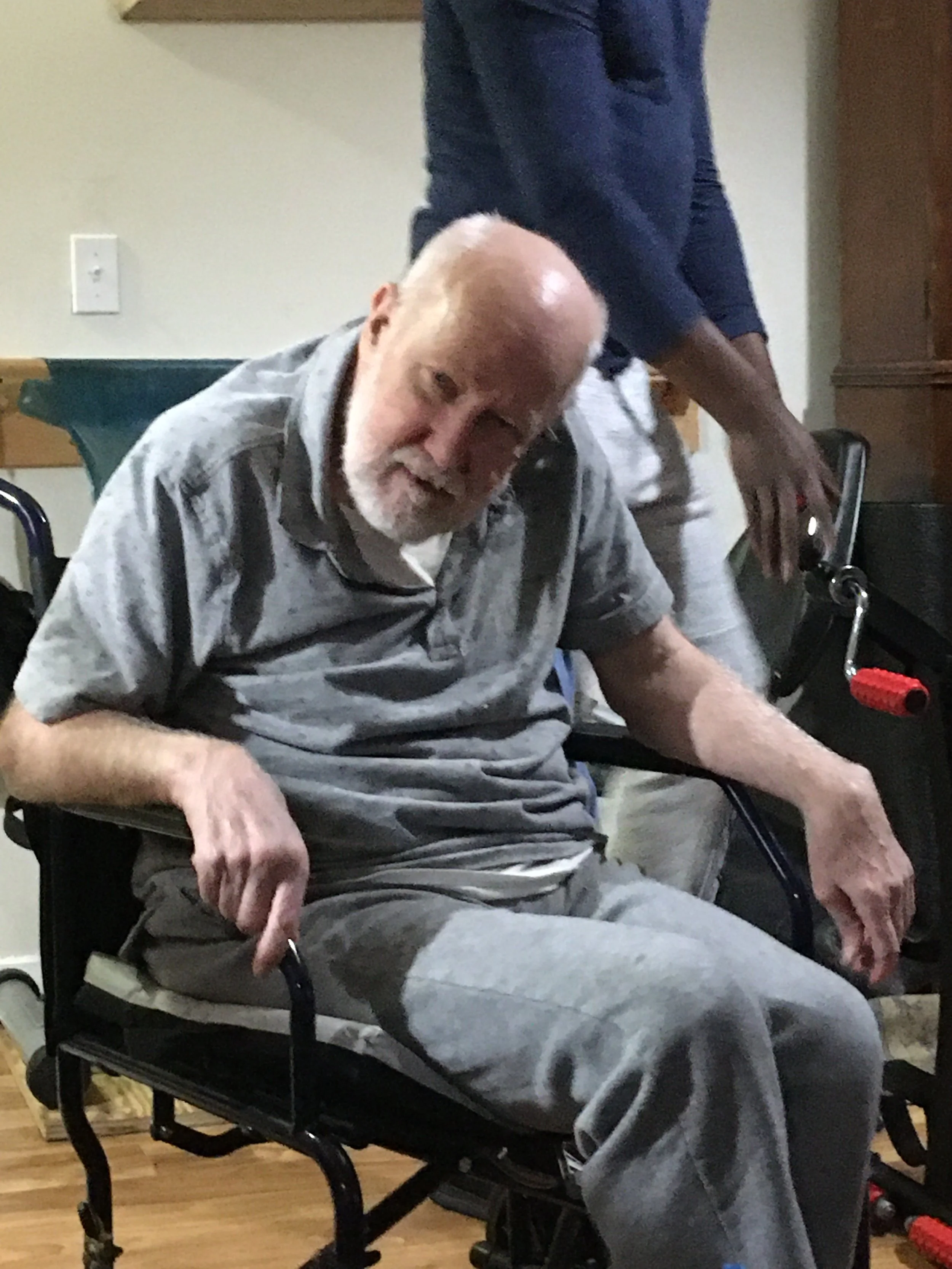
David: The Real Story
I think we are not trained to understand that although a person can commit suicide by taking too many pills, they can also give up living by refusing to eat or drink anymore. We do not see the almost invisible signs of the silent, yet all-powerful, wish to give it all up. We think that it is just a passing phase of depression.
David did not lack courage, yet perhaps he was long haunted by the fear of failure. He went to a good private school in New York City, and then to boarding school, as many young, somewhat-monied young boys of East Side NYC did. Then on to Princeton, Colombia graduate school, but finally, he did not want to wangle out of serving overseas during Vietnam by using influence to serve at some capacity stateside. Was he somehow already plagued by the fear of failure in the competitive schools? Did he have the need to prove that he was just as able to serve as any other enlisted soldier?
David served in Vietnam for approximately 11 months and was assigned to fly helicopters, delivering secret codes and equipment to troops engaged in combat. One day, as the helicopter hovered above a site, he realized that the soldiers were being encircled by the enemy. Quick thinking saved many lives, and he was awarded a Bronze Star Medal for his actions.
The return of any Vietnam vet was difficult, but he managed to weather it, focusing on playing tennis and teaching the sport to the next generation. He was also influenced by Martin Luther King and, together with a group, formed a small scholarship fund for college-bound kids. Finally, he zeroed in on law and excelled in legal research.
At the law firm, David’s astute ability to analyze and research the law earned him praise, and he was celebrated for his valuable contribution to that firm and to a lawyers’ committee he served on. The committee later started giving an annual award in his name to lawyers and even a judge or two. There was a ditty honoring David, which was sung to the tune of ‘And here's to you, Mrs. Robinson, ’ which culminated the festive event.
Yet, already a few years before that, David realized that he had Parkinson’s disease, and his ability to work began to diminish before his very eyes. The firm was good to him and allowed him to come to work so he could continue to receive excellent health care. Finally, however, it became apparent that David was unable to put even a few paragraphs together, and they had to let him go. But David was not a quitter. He constructed ‘monkey bars’ hanging from the ceiling that let him hang on and sprint from room to room in the strange way that Parkinson’s patients seem to move faster and jerkier than the rest of us. When he felt especially helpless against his disease, he would call 911 (often). They would transport him to the emergency room, but sadly, he himself predicted that science would not progress fast enough for him.
For a while, he focused his energy on the legal issues surrounding our parents’ estate, which gave him a reason to keep up the fight, much to our siblings' annoyance. But once the estate was settled, there was little else for him to try to use his keen mind on.
He moved to Atlantic City, and this time he constructed bars over his bed, which made it easier for him to get out. But the days of swinging from room to room were gone. He did some ‘boxing’ for Parkinson’s patients, some physical therapy, and voice therapy to help project his voice. But therapy is only ordered when there is progress, not to maintain the good health of the Parkinson’s patient. The caregivers’ kids also came after school to sit with him. Then COVID came, and he became even more isolated.
He knew that he had probably only one to three years to live, as he told one of his doctors at the VA. Yet, he was delighted when, for his last birthday, he was given a few spiral notebooks and pens. He felt he could write again and fall back on the skills he once had, though by then even he could not read what he had written.
After COVID, he enrolled in a daycare program. At first, all seemed to be well. David reveled in being in a room with lots of other older people, many in wheelchairs like him. Yes, he sometimes dozed off during lunch, and, being naturally skinny, he didn’t seem to need to eat much anyway. This annoyed the staff. They had it in their mind that you had to be awake at lunch, and you had to pretend to eat what they served. But once, when he asked for an extra glass of juice, this was considered completely out of line. Everyone got one glass and only one glass. He was told that this was not like at his home, where the caregiver could cater to his every need.
David started hormone therapy for his prostate cancer, and he also began to have trouble swallowing his capsules. At his request, the VA changed his medication to tablets for a brief time. As predicted, the tablets did not give him the full benefit of the time-released ‘Rytardy’ capsule (aptly nick-named). For a while, he had less energy and seemed to nod off in sleep more often. Once feeling weak during this time, he asked for coffee (although he never drank it at home). He was strictly reminded that this was not like at his home, where people answered to his every wish.
Nor did David always want to eat, and sometimes he was quite vocal when Management tried to pressure him into eating. In fact, Management had decided that ‘he is intentionally disruptive.’ They would put him in ‘isolation’ and often called his caregiver to pick him up. They punished him by suspending him from daycare to teach him to behave appropriately. One time, the nurse reported to me that he had replied to her that he was going to die. As impossible as it was for her to understand, I offered something about the fact that he was well aware of dying soon.
One day, David had gotten ready for the school bus to pick him up, and when the caregiver called the office to find out why the bus driver had not arrived, he was told that David was suspended yet one more day for his intentional bad behavior. Possibly, if the bus had been a black limousine rather than painted yellow, it might have occurred to them that he was not a willfully wicked child, but an older man with diminishing abilities who, in serving his country honorably, had come down with a condition that was like a death warrant that had haunted him for more than two-and-a-half decades.
Management felt they had to teach this 78-year-old Vietnam veteran how to act, forgetting his condition and his recent hormone treatment, and ignoring that he was not a child. Maybe the others in wheelchairs at the center were on sedatives or were people who had learned to bow to authority. But David felt he had the right to refuse food if he didn’t want to eat, and that at his age, he had the right to doze off. Moreover, bingo was difficult for him despite having had both eyes operated on for cataracts and being prescribed glasses for distance. Nor did the game mean much to him anyway. David liked to analyze history and politics, but could be comfortable at least sitting among other ‘wheelchairers’ rather than waiting long hours at home for the caregiver’s children to come home after school. He enjoyed the passive companionship. The more Management tried to tell David that he was intentionally behaving inappropriately, the more he tried to assert his rights. For their part, they showed no interest in treating him with any appropriate courtesy or respect. Slowly, they eroded the pleasure he had once savored by punishing him for various ‘infractions’ like nodding off frequently.
Then one day, Management foisted a sandwich into David’s hands and told him to eat it. He took one bite and then threw it on the floor.
This was the end for Management. They decided to punish David by expelling him from the daycare. Hurriedly, they wheeled him towards the door so that the bus driver could take him home, but David was so distraught that even from his wheelchair, he managed to cling onto the sides of the doors and continued to repeat tearful pleas begging them to reconsider. The commotion was so loud that Management changed their plan and wheeled him down the hall to an isolated room. Then they called David’s caregiver to come pick him up.
When the caregiver arrived, David was so extremely distraught that the caregiver spent about 45 minutes in the isolated room trying to calm him down. Finally, David’s caregiver was able to coax him into his car. Yet even as the caregiver helped David out of the building, he kept on tearfully pleading for just one more chance. He hoped things could be ‘renegotiated,’ using the language from his years of legal training. They held fast to their decision, though, and said no one could convince them not to kick him out.
Strangely enough, just being able to be there in the group, even if he nodded off during lunch and didn’t like to play bingo, meant a lot to David now in the most fragile stage of his life.
Here was the bronze-medal recipient who had risked his life for our country. Here was the Princeton graduate with a master’s degree from Columbia University. Here was the celebrated legal researcher who had been lauded with a “Mrs. Robinson” rhyme. Now, here was this 100% disabled veteran being told at the end of his life that he had failed daycare.
Four hours later, David refused to eat anymore, and he didn’t take his Retardy. He mentioned the idea of suicide but had no apparent access to any means. Twelve days later, he died.